


Últimas noticias


 At the same roundtable in New York, DFI, New Rules for Global Finance and the Friedrich Ebert Stiftung are also launching the report: Are The Multilateral Organisations Fighting Inequality?, which analyses the impact that the UN, IMF, OECD, World Bank, FSB and G20 are having on supporting countries across the world to fight inequality more effectively. The report scores and ranks each of the organisations for their impact across various policy transmission mechanisms, especially on tax, spending, labour and development financing policies. It finds that readiness and impact in fighting inequality is greatest in the UN, especially through its support to countries provided by UNDP and specialised agencies such as the ILO, UNICEF, UNESCO, WHO and UN Women.
At the other end of the spectrum, the G20 has only focussed intermittently on inequality and has therefore achieved very little. The report has been compiled through a lengthy process of consultation with experts from within each institution and inputs from independent representatives of civil society organisations working on inequality issues, including the ITUC, Oxfam, SOAS, Finance Watch, the University of Laval and RTpay. You can now consult the executive summary.
Leer más...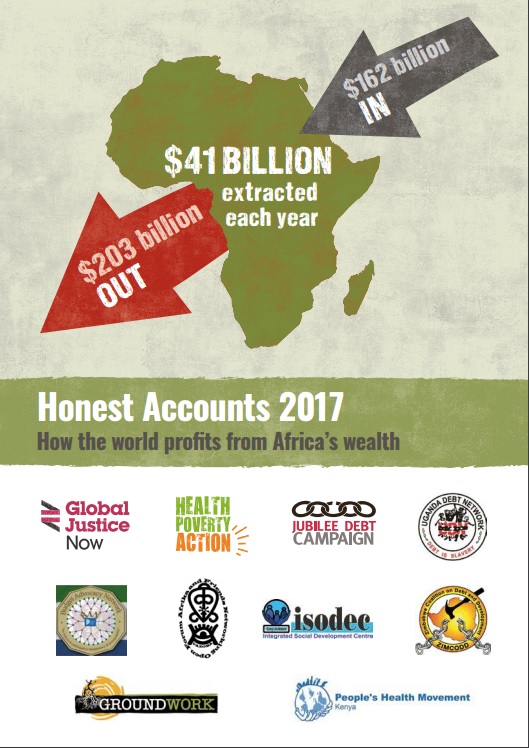 According to new research, much more wealth is leaving Sub-Saharan Africa than is entering it. By calculating the movement of financial flows, the study reveals that the world’s most impoverished continent loses $203 billion through factors including tax avoidance, debt payments and resource extraction. Despite receiving resources such as loans, remittances and aid amounting to $161.6 billion, the continent’s annual net financial deficit is over $40 billion.
The report, published by a coalition of UK and African organisations, makes a series of recommendations as to how the system extracting wealth from Africa could be dismantled. Proposals include promoting economic policies that lead to equitable development, preventing companies with subsidiaries based in tax havens from operating in African countries, and transforming aid into a process that genuinely benefits Africa.
 The International Budget Partnership (IBP) has published a budget brief which explores good practices and lessons learned from monitoring government budgets and expenditure on the MDGs. The aim of this brief is to assist with monitoring, reporting, and accountability, in respect of the SDGs.
Featuring summaries of case studies from 11 countries, the brief presents findings from research by DFI in collaboration with IBP that draws on DFI’s Government Spending Watch (GSW) initiative, which monitored MDG-related spending across 72 developing countries. The research looked at budget transparency practices, the relative ease of identifying MDG, budget classification and presentation for both planned and actual spending.
To support this brief, DFI produced a background paper prepared for IBP which aims to establish lessons to inform advocacy efforts to promote greater budget transparency and accountability in the SDGs implementation framework.
 DRI participated in the World Bank Debt Management Facility Stakeholder Forum in Vienna, taking part in the ICG governance meeting of the facility, and making a presentation on Debt Sustainability Status and Prospects in the Forum itself. The presentation, reported on the uses by countries of the LIC DSF template, on debt sustainability issues and reviewed the main conclusion of a study undertaken by DRI for DFID and the AfDB.
 An article published on the Interpress News Service Agency delves into the details of the World Bank’s Doing Business in an attempt to lift the veil on what underpins the ranking and reveal its pitfalls.
The authors find, among other things, that countries promoting lower corporate tax and more exemptions are ranked more favourably than others, therefore encouraging harmful tax competition among developing countries. They call for the World Bank to focus efforts on assisting developing countries in improve tax administration to enhance collection and compliance, and to reduce evasion and avoidance.
 For the past seven years, finance ministers from low-income Francophone countries have met in the margins of the Annual Meetings of the IMF and the World Bank to discuss financing for development. Under the aegis of the International Organization of La Francophonie (OIF), DFI helped convene the latest meeting in Washington on 20th April.
 A new briefing by the Jubilee Debt Campaign (UK) focuses on the failures of PPPs in the UK. Aimed at an international audience to inform civil society and decision makers across the world, “The UK’ PPPs Disaster: Lessons on Private Finance for the Rest of the World” sets the record straight about the true record of PPPs in the UK, by revealing the shortcomings of what is an unpopular financing mechanism.
 In a report co-published with Oxfam International, Eurodad focuses its new piece of research on blended finance. Combining official development assistance (ODA) with other private or public resources, in order to ‘leverage’ additional funds from other actors, “blended” finance has become a common development finance term over the last few years.
However, there is a level of confusion around the way this development finance mechanism operates, coupled with a relative lack of data from blending projects. With an aim to shed light on this concept, the report clarifies what blending is, how it works and how it is used. It identifies areas that are crucial to maximize the development impact of blending projects, while providing an assessment of the associated quantitative and qualitative risks.
 A joint World Bank/DRI visited Maputo, Mozambique during the month of February, 2017. The objective of the mission was to assess the existing legal, institutional and technical environment in which debt management takes place in Mozambique using the DeMPA methodology. The mission met with government officials at the Ministry of Finance, Banco de Mozambique, Tribunal Administrativo, and the Stock Exchange and prepared a document that will be submitted for peer review and then to the Mozambican authorities for comments.
 DFI helped to facilitate an Oxfam Southern Africa workshop which aimed at designing programmes to achieve fiscal justice at regional and national levels. DFI presented on global, regional and national trends in tax policies, budget financing (aid and debt), and spending policies, and assisted Malawi, South Africa, Zambia and Zimbabwe to identify their priorities for future country and regional work. Among the key priorities emerging were a regional index on fiscal justice and inequality, incidence analysis, tax incentives, gender budgeting, and extractives revenue-sharing.
