


Últimas noticias


 DFI participated in a training and technical assistance mission at Senegal’s National Debt Committee in order to design a 5-year medium-term debt management strategy (MTDS), over the 2017-2021 period. The mission found that Senegal’s level of debt has grown at a steady rate since 2006. It also observed an increasing emphasis of commercial debt in its portfolio, despite the country’s priority to mobilise concessional resources to finance the projects laid out in the national development plan (Plan Sénégal Emergent).
The mission also found that the National Debt Committee’s significant technical capacity to develop a debt strategy was thwarted by a few issues: difficulties in following up the implementation of the strategy; a clash with other sectors’ strategic orientations fixed by the MTDS, communication and dissemination concerns, as well as problems with the publication of the strategy which remains to be approved by the political or ministerial authority.
 A joint World Bank/DRI visited Dushanbe, Tajikistan, with an aim to develop a debt management reform plan and present it to the authorities. The Reform Plan included the following areas: medium-term debt strategy, debt sustainability analysis, developing the domestic market, debt data and recording. The Plan also included a logframe to implement the proposed actions as well as a training program.
The mission met with government officials at the Ministry of Finance, Central Bank, and other institutions involved in debt management.

 DFI facilitated the second OIF technical workshop on tax policy in Abidjan from 6 to 9 December. The workshop was organised in partnership with the government of Côte d’Ivoire, as well as CREDAF, the IMF, LSE, OECD, UEMOA, the University of Paris, UNDP, and the World Bank. Director-Generals and ministerial fiscal policy advisors from 14 Francophone countries attended the
 A joint World Bank/DRI mission visited Sao Tomé and Príncipe in order to assess the existing legal, institutional and technical environment in which debt management takes place in Sao Tomé, using the DeMPA methodology. The mission also assessed the degree in which the existing Reform Plan had been implemented and developed an updated debt management reform plan that included the following areas: medium-term debt strategy, capacity building, developing the domestic market, debt data and recording.
 DFI took part in the joint World Bank-IMF technical assistance mission to Lomé, Togo, in order to develop a medium-term debt management strategy (MTDS) for the 2016-2020 period. In support of Togo’s National Public Debt Committee, the mission showed that the country has a capacity to build a database in line with the required format which will enable the design of the strategy.
However, implementing the strategy is being thwarted by deficiencies in terms of institutional coordination. While systematically annexed to the budget law, the strategy is still not being used as a guiding document in the negotiation and mobilisation of loans, because of the lack of political and technical appropriation towards it.
 Jubilee Debt Campaign, along with the Integrated Social Development Centre, SEND Ghana, Vazoba, Kilombo, AANCLID and the Abibimman Foundation, have published a new report on Ghana’s debt situation.
The report reveals that the World Bank broke its own rules to guarantee 10.75% interest loans to Ghana. It shows how Ghana is in a new debt crisis just a decade after having significant amounts of debt cancelled by international lenders. While debt cancellation in 2004 and 2005 gave the country breathing space to increase spending on public services, the commodity price crash and currency shocks since 2013 have seen debts rapidly building up once again.
Read the full Jubilee Debt Campaign press release and the executive summary and full report here.
This issue has also been covered in The Guardian newspaper.
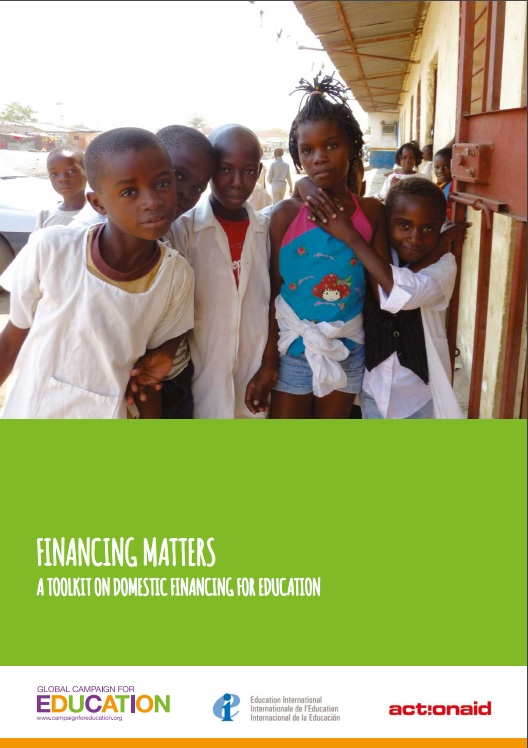 Drawing on the skills gained from monitoring government budgets in over 70 countries, Government Spending Watch (GSW) helped develop a toolkit on Domestic Financing for Education produced by the Global Campaign for Education (GCE) in collaboration with ActionAid International (AAI) and Education International (EI).
As the world embarks on the difficult task of putting into action the newly agreed SDG 4, and the accompanying Education 2030 Framework for Action (FFA), this toolkit aims to support CSOs and education activists across low- and middle-income countries to advocate and campaign on issues related to financing for education.The SDG 4 and the FFA contain collective commitments to ensure inclusive and equitable quality education and lifelong learning for all by 2030 - which will require ambitious new financing commitments to meet this goal.
Leer más... Finance ministers from low-income Francophone countries met in Washington on 6th October 2016 to discuss financing for development with other Francophone countries. Under the aegis of the International Organisation of La Francophonie (OIF), DFI helped convene this meeting in the margins of the Annual Meetings of the IMF and the World Bank.
Chaired by Mr. Abdoul Aziz TALL, Minister in the Presidency for the Plan Senegal Emergent, and co-chaired by Mr. François Maurice Gervais RAKOTOARIMANANA, Minister of Finance and Budget of Madagascar; and Mr. Ousmane Alamine MEY, Minister of Finance of Cameroon, the meeting was an opportunity for LIC ministers to take stock of work in 2015-2016 among Francophone countries to analyse how to finance their development and on domestic resource mobilisation.
Leer más... DFI was commissioned by UNESCO to provide a background paper and case studies which were used for the new Global Education Monitoring Report. This publication series provides independent monitoring and reporting of the Sustainable Development Goal on education (SDG 4) and on education in the other SDGs, for the next fifteen years.
The 2016 instalment entitled “Education for People and Planet: Creating Sustainable Futures for All” aims to bring insight for governments and policymakers to monitor and accelerate progress towards SDG 4.
 Despite stable overall public spending figures, DRC’s expenditure in some key social sectors as percentage of total expenditure has declined from 2014 to 2015, notably in health and agriculture. GSW’s latest country spending summary highlights DRC’s shift of budgetary priorities in an election year where government spending seems to be reoriented towards public order and security, and infrastructure projects.
 Brussels-based organisation Eurodad has published a discussion paper which analyses the evolving nature of debt in developing countries and investigates currently available solutions for change. In a context where developing country debt is increasing, despite taking a relative downward path between 2000 and 2010, this report aims to figure out the reasons behind this debt burden increase, analyse the risk of new debt crises and to examine the changing nature of the type of debt countries are now facing. It also makes recommendations for sustainable and progressive solutions to prevent further debt crises and to improve policy processes of crisis resolution and management.
